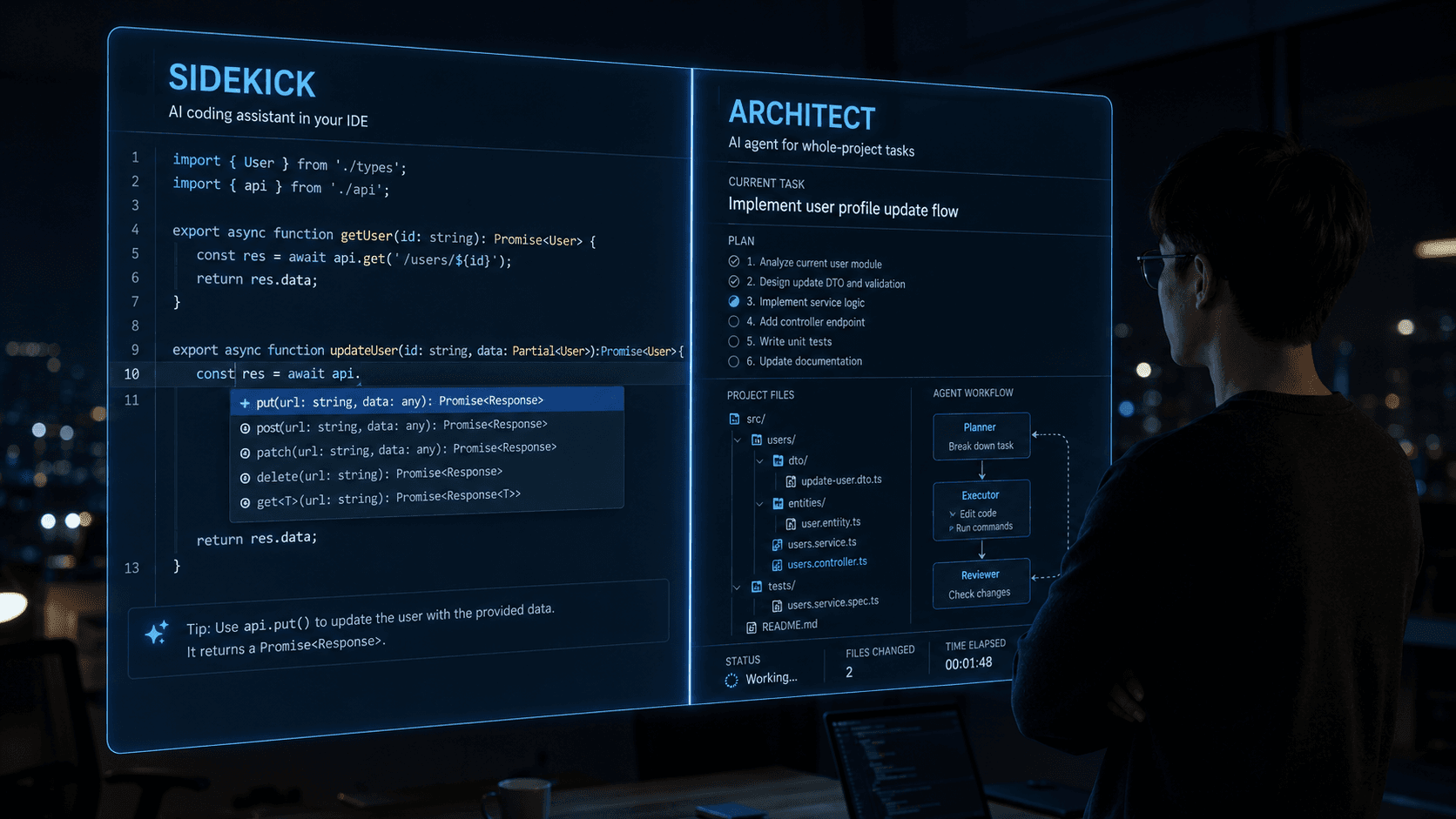
GitHub Copilot or Claude Code? Thinking about which AI tool to use? This can help!

Both write code. Both are very good. But they are not the same kind of tool at all—and picking the wrong one for the job is the fastest way to be disappointed by an AI that is actually working fine.
A sidekick and an architect
The cleanest way I've found to describe the difference is this: GitHub Copilot is a brilliant programming sidekick—true to its name—and Claude Code is a master planner.
Copilot lives inside your IDE. It offers on-the-fly autocomplete, coding guidance, and debugging help exactly where your cursor already is. You stay the pilot; it rides along, finishes your sentences, and catches you when you fumble a regex at 1 a.m.
Claude Code operates from a different altitude. It helps you build a creative concept from the ground up. It is capable of refactoring and debugging too, but its CLI or dedicated interactive interface positions it as a comprehensive tool for end-to-end coding innovation, not merely an assistant.
The plot twist: Copilot sometimes is Claude
GitHub Copilot sometimes uses Claude's models. Copilot is a product with a model picker, and Anthropic's models sit alongside others. So "which model is smarter" is often the wrong question—you may be talking to the same brain through two very different doors. The real difference is the harness: what the tool is allowed to see, touch, and do on your behalf.
What Copilot is genuinely great at
Flow. Inline completions are fast and cost you almost nothing in attention: you keep typing and accept what's right. For boilerplate, test scaffolding, and "I know exactly what I want but not the syntax," nothing beats it.
It's also cheap and predictable. Its agent mode can plan multi-step edits, run terminal commands, and iterate, while the IDE remains the center of gravity.
What Claude Code is genuinely great at
Scope. Because it isn't tethered to whatever file you happen to have open, it reasons about the whole project. Plan mode proposes an approach and waits for approval; subagents handle side-quests in their own context windows; and MCP lets it query a database, call an internal API, or read an issue tracker as part of a task.
Add hooks—deterministic scripts that fire at defined points—and it stops feeling like autocomplete and starts feeling like delegation. Being CLI-first also means it can go wherever your terminal goes: a server, a container, or CI.
Copilot makes you faster at the code you were already going to write. Claude Code writes the code you were dreading.
My honest take after using both
They're complements, not rivals, and I run both. My rough dividing line: if I can describe the change in one sentence and see the file, that's Copilot. If describing it takes a paragraph and touches five files I haven't opened yet, that's Claude Code.
Claude Code is only as good as your brief, so use plan mode for broad tasks. Agentic tools also burn tokens quickly: reach for the agent when the task deserves it, not for a one-line fix.
So which should you pick?
If you mostly maintain an existing codebase, work in one IDE, and want speed without changing habits, start with Copilot. If you're building something new, orchestrating work across many files and services, or want an AI that can be handed a goal instead of a line, start with Claude Code.
And if you can afford both, the combination is better than either. Let the sidekick keep you in flow, and call in the architect when the problem is bigger than the file you're staring at.
Sources

Tom Wang
Master's Student, Northeastern University
MS ECE concentrated in Computer Vision, Machine Learning, and Algorithms, Graduate Student from Northeastern University, Boston. Have a strong interest in software development, Artificial Intelligence/Machine Learning research, and algorithm studies. Participated in related projects and internships such as data analysis using ML methods, machine learning driven algorithms, large model deployment & fine-tuning and multimodal content defense research.

Max Li
Founder, Grassrootech
max@grassrootech.comMax is dedicated to bridging the gap between advanced research and practical industry application. Drawing on his experience at IBM Research and Union University, he leads the development of AI solutions that drive meaningful progress.
Read More

What Should You Do If You Have Used Up Your Quota for OpenAI Codex?
OpenAI Codex is excellent, but quota limits are real. Here is a practical fallback strategy for developers who want to keep building without jumping immediately to a more expensive plan.

Have you heard of OPC: One Person Company?
AI is making a new kind of company imaginable: one person coordinating agents, software, and distribution with the leverage of a much larger team.