
Ask AI to ask you questions

Almost every prompting tip is about writing better instructions. The most useful one I've found this year runs the other way: stop instructing, and let the AI interrogate you first.
Reverse prompting
Alex Finn calls it reverse prompting, and pitches it as the greatest AI prompting technique there is: have your AI ask you questions, to see what it can do for you. His claim is that it makes any AI or OpenClaw dramatically more powerful.
OpenClaw is the open-source personal AI assistant formerly known as Clawdbot. It runs on your own machine and plugs into apps like WhatsApp or Telegram, so it can execute tasks rather than just chat about them. The point in naming it: the technique isn't model-specific, and the more autonomy a system has, the more it matters that it understood you correctly.
The exercise takes about five minutes. Open any AI, brain dump everything about yourself and your goals, then send this:
"Based on what you know about me and my goals, what is more information I can provide to you in order for you to be able to help me achieve my goals faster and take as much off my plate as possible"
Once you've answered, follow with:
"How can you help me get closer to all of my goals? What tasks can you do for me?"
Finn guarantees 100x more ideas for what to do with your AI than you'd had before. That number is marketing, but the direction is right.
What it looks like in real work
Here's my own example, from a data-model change: four household types instead of three, a rename of the families collection to households, and matching updates to the registration UI. Then one line at the end: ask me any questions first before working on it.
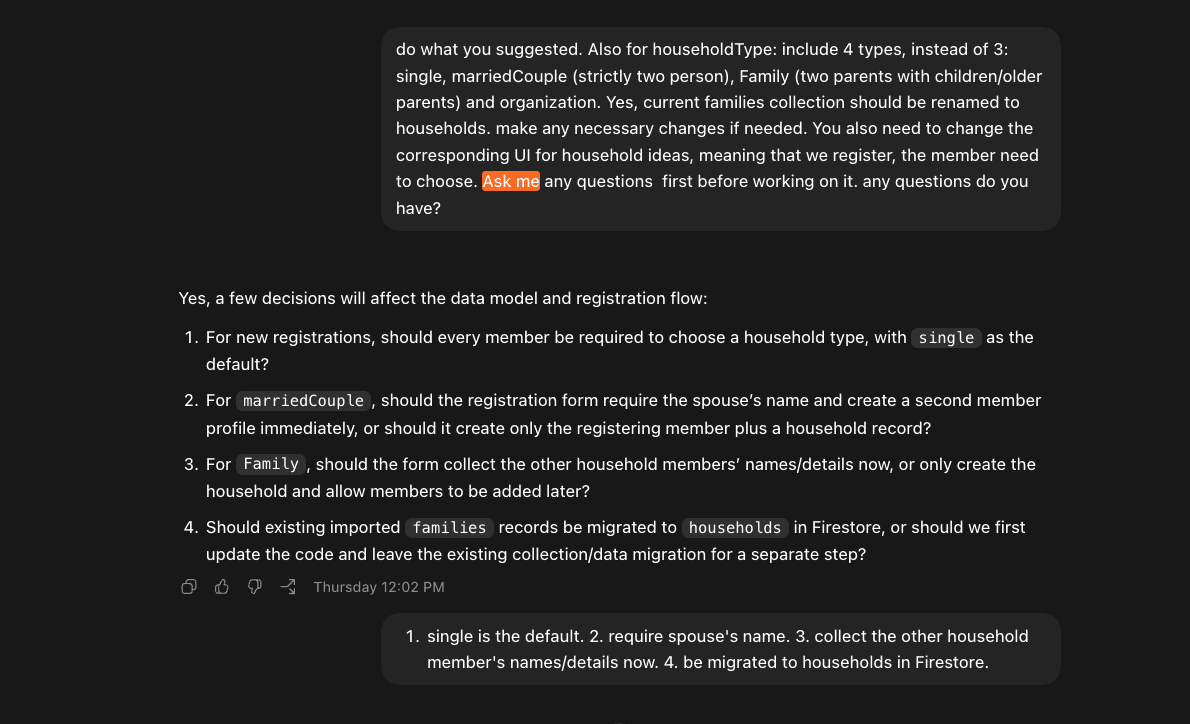
It came back with four: the default type for new registrations, whether marriedCouple should immediately create a second member profile, whether Family should collect other members' details now or later, and whether existing families records should be migrated in Firestore or left for a separate step.
Every one was a genuine fork. Unasked, it would have picked plausible answers to all four—and I'd have disagreed with at least three. Thirty seconds of typing bought a build that was right the first time.
Why this works
The principle is a mismatch in how the two sides think. Humans are imprecise and inconsistent, and our ideas arrive isolated—a prompt is a lossy compression of a mental model we never fully wrote down. AI is the opposite: systematic, and unusually good at spotting ambiguity, because it has seen thousands of similar specs and knows where they branch.
So the gaps get filled either way—the only question is whether by your answer or by the model's default. Reverse prompting moves that decision to you, and it's cheap: a question costs seconds, a confidently wrong implementation costs a whole build-review-discard cycle.
An unasked question doesn't disappear. The model just answers it for you, silently, using a default.
It isn't always the right move
No, this is not universally effective. On trivial tasks it's pure friction. A thin brain dump produces generic questions. And it only surfaces ambiguities the model can perceive: it will never ask about the undocumented internal constraint it has no way of knowing exists.
The subtler risk is a false sense of completeness. Answering five confident questions feels like alignment, but the riskiest assumption may be the one that never got asked. Questions are a spotlight, not a floodlight.
What to watch for
- Cap it. Ask for the three highest-impact questions, then start.
- Answer in the same numbered form, one clause per item.
- Treat unanswered questions as findings. They are holes in your own design, not the model's.
- Persist the answers into a spec or rules file.
- Verify the output reflects them. A model can ask good questions and still drift.
One caution on Finn's version specifically: "brain dump everything about yourself" means real personal data going into someone's system. Know your retention settings before you empty your life into a chat box.
The habit that stuck for me is smaller than the full exercise: just ending any non-trivial request with any questions before you start? You're not asking the AI to be smarter—you're asking it to tell you what you forgot to say.
Sources

Tom Wang
Master's Student, Northeastern University
MS ECE concentrated in Computer Vision, Machine Learning, and Algorithms, Graduate Student from Northeastern University, Boston. Have a strong interest in software development, Artificial Intelligence/Machine Learning research, and algorithm studies. Participated in related projects and internships such as data analysis using ML methods, machine learning driven algorithms, large model deployment & fine-tuning and multimodal content defense research.

Max Li
Founder, Grassrootech
max@grassrootech.comMax is dedicated to bridging the gap between advanced research and practical industry application. Drawing on his experience at IBM Research and Union University, he leads the development of AI solutions that drive meaningful progress.
Read More

What Should You Do If You Have Used Up Your Quota for OpenAI Codex?
OpenAI Codex is excellent, but quota limits are real. Here is a practical fallback strategy for developers who want to keep building without jumping immediately to a more expensive plan.

Have you heard of OPC: One Person Company?
AI is making a new kind of company imaginable: one person coordinating agents, software, and distribution with the leverage of a much larger team.