2026 World Cup is over — Spain won the title, sponsors won the revenues, AI won the... future?

A month of football across three countries ended with Spain lifting the trophy in New Jersey. But the moment that will define this tournament in ten years' time wasn't a goal. It was a goal that got erased—by a strand of hair.
The goal a strand of hair erased
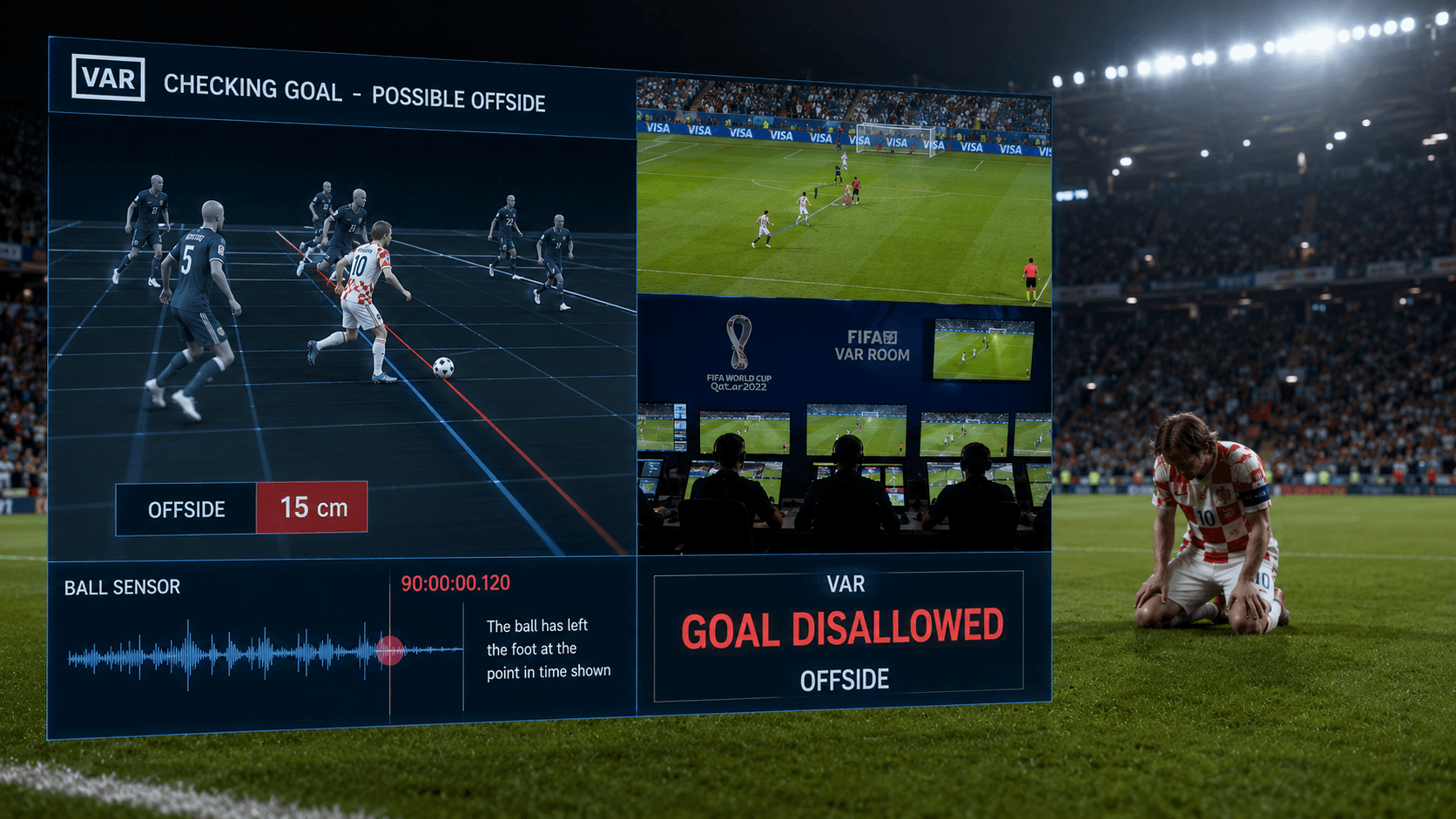
Toronto, round of 32. Croatia are trailing Portugal, twelve minutes into stoppage time, when Joško Gvardiol smashes in what looks like one of the most dramatic equalizers in World Cup history. Bedlam in the stands. Then the pause. Referee Espen Eskas walks to the pitchside monitor.
What undid Croatia was something no camera caught: the faintest contact off Igor Matanović's hair in the build-up—invisible in every television replay—which flipped Mario Pašalić onto the wrong side of the offside line. FIFA's statement said the ball's own data had proven the touch. Goal disallowed. Cristiano Ronaldo, 41, marched on. Luka Modrić, 40, went home from his final World Cup, consoling a distraught Mateo Kovačić while bottles rained onto the turf.
The ball is a computer now
That verdict came from hardware, not eyesight. The Adidas Trionda hides a 500 Hz inertial sensor inside one of its four panels, built with Kinexon, logging acceleration, spin and every contact five hundred times per second—the other three panels counterweighted so the flight stays honest. (Yes, the official match ball has to be charged.) Overhead, cameras under the stadium roofs track 29 points on every player's body, feeding a semi-automated offside system that can flag margins as fine as ten centimetres.
Put them together and a call that once took a linesman's raised flag and ten minutes of shouting now resolves in seconds, then arrives on hundreds of millions of screens as a tidy animated 3D verdict. Certainty, delivered at broadcast speed.
The algorithms nobody bought a ticket for
The machines didn't stop at the touchline. Before the players reached the tunnel, recommendation models had already carved the match into highlight clips and pushed them at exactly the users statistically likely to watch. Betting firms' models repriced the next round within seconds of the final whistle. And somewhere in a Spanish analysts' room, every shot Ronaldo had taken all tournament was being poured into expected goals (xG) datasets—by Portugal's next opponent.
Spain met Portugal in the round of 16 in Dallas and won 1–0 through a Mikel Merino strike deep into stoppage time, ending Ronaldo's World Cup career. Then Belgium, 2–1. Then France. Then Argentina in the final at New York/New Jersey Stadium on 19 July: 1–0, Ferran Torres in the 106th minute, Enzo Fernández sent off, Emiliano Martínez making a record eleven saves in defeat. Spain's second star. Whether those xG models actually moved the needle is unknowable—but no one competing at that level is willing to go without them.
Sponsors won the revenues
Off the pitch, the scoreboard was even more lopsided. FIFA's 2023–26 commercial cycle closed at roughly $15 billion, up more than 70% on the last one. Sponsorship alone reached $2.8 billion with all sixteen global slots sold out, against $1.8 billion in 2022. Broadcasting brought in about $3.9 billion, ticketing and hospitality more than $3 billion, licensing another $484 million. The tournament also imported American pricing culture wholesale: dynamic ticket prices and an official resale platform, with seats for the final listed near $11,000.
Forty-eight teams, 104 matches, three host nations—and underneath it, a beautifully tuned machine for converting global attention into money, running on the same species of model that wiped out Gvardiol's goal.
The ball keeps the ledger now. So do the cameras, the odds, and the highlight feed.
Football was just the pilot program
None of this stays inside football. Major League Baseball rolled its Automated Ball-Strike Challenge System out league-wide for the 2026 season: human umpires still call the game, but each team gets two Hawk-Eye-adjudicated challenges, kept if they're right—while Statcast now logs bat speed, swing path and player biomechanics as a matter of routine. In the NBA, Second Spectrum cameras in all 30 arenas track every player and the ball 25 times a second, and the league's AWS-powered analytics platform turns billions of those data points into insights fast enough to use during the broadcast.
Tennis line judges are already gone. Formula 1 teams simulate strategy in real time. The pattern repeats everywhere the stakes are high enough to pay for it.
So who actually won?
Spain lifted the trophy. The sponsors banked the cycle. And AI quietly won something less visible than either: the argument about whether it belongs in the room at all. That question is settled now. The open one is how much judgment we're prepared to hand over—and whether it still feels like a game when a strand of hair, measured five hundred times a second, decides who flies home.
Sources

Tom Wang
Master's Student, Northeastern University
MS ECE concentrated in Computer Vision, Machine Learning, and Algorithms, Graduate Student from Northeastern University, Boston. Have a strong interest in software development, Artificial Intelligence/Machine Learning research, and algorithm studies. Participated in related projects and internships such as data analysis using ML methods, machine learning driven algorithms, large model deployment & fine-tuning and multimodal content defense research.

Max Li
Founder, Grassrootech
max@grassrootech.comMax is dedicated to bridging the gap between advanced research and practical industry application. Drawing on his experience at IBM Research and Union University, he leads the development of AI solutions that drive meaningful progress.
Read More

What Should You Do If You Have Used Up Your Quota for OpenAI Codex?
OpenAI Codex is excellent, but quota limits are real. Here is a practical fallback strategy for developers who want to keep building without jumping immediately to a more expensive plan.

Have you heard of OPC: One Person Company?
AI is making a new kind of company imaginable: one person coordinating agents, software, and distribution with the leverage of a much larger team.